




 How to add an SSL monitor...
Dynu's System Monitoring & DNS Failover service helps you monitor critical services
from multiple geographic locations and automatically respond when downtime is detected.
You can log into the control panel to add and manage your monitors.
An SSL monitor checks the validity and health of the SSL/TLS certificate served by a host on a specific port. It is useful for ensuring that your HTTPS website, mail server, or any other TLS-secured service presents a valid, trusted, and unexpired certificate. The monitor can warn you before a certificate expires and can also detect untrusted, revoked, or misconfigured certificates. If the SSL check fails from two or more geographic monitoring locations, you will be notified and any configured failover actions will be triggered.
To add an SSL monitor in the control panel, you may follow these 3 steps.
 Step 2
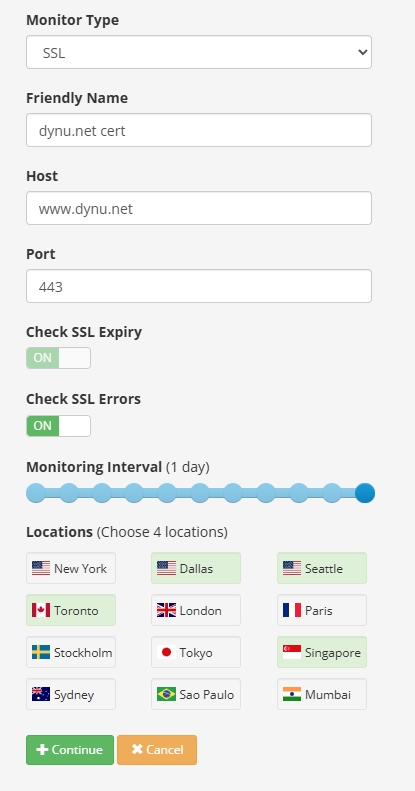
Configure your SSL monitor using the following fields.
Monitor Type Choose "SSL".
Friendly Name A descriptive label for the host and certificate being monitored. This name will appear in any notification emails sent to you. For example, dynu.net cert .
Host The hostname or IP address of the device whose SSL/TLS certificate will be inspected. Do not include a protocol (such as https://) or a path. For example, www.dynu.net .
Port The TCP port on which the SSL/TLS handshake will be performed. Enter the port used by the secured service you want to monitor (e.g., 443 for HTTPS, 465 or 587 for SMTPS, 993 for IMAPS, 995 for POP3S). For example, 443 .
Check SSL Expiry When set to ON, the monitor will treat an expired certificate — or one that is close to its expiration date — as a failure, giving you advance warning to renew the certificate. Set to OFF if you do not want expiration to trigger an alert.
Check SSL Errors When set to ON, the monitor will treat invalid, untrusted, revoked, or otherwise misconfigured SSL certificates as failures. Recommended for production endpoints. Set to OFF if you are monitoring a server with a self-signed certificate or a non-standard SSL configuration.
Monitoring Interval How often the SSL check is performed. You may choose any value between 1 minute and 1 day using the slider. For example, 1 day .
Locations Choose 4 geographic monitoring locations from the available list (e.g., New York, Dallas, Seattle, Toronto, London, Paris, Stockholm, Tokyo, Singapore, Sydney, Sao Paulo, Mumbai). Your certificate is checked simultaneously from all selected locations, and a failure must be confirmed from two or more locations before an alert is triggered — eliminating false alarms from single-point network issues.
Step 3
Click Continue to save the monitor. You can then proceed to set up notification contacts and failover actions for this monitor.
What is an SSL monitor?
An SSL monitor checks the validity and health of the SSL/TLS certificate served by a host on a specific port. It is useful for ensuring that your HTTPS website, mail server, or any other TLS-secured service presents a valid, trusted, and unexpired certificate. The monitor can warn you before a certificate expires and can also detect untrusted, revoked, or misconfigured certificates. If the SSL check fails from two or more geographic monitoring locations, you will be notified and any configured failover actions will be triggered.
How to add an SSL monitor?
To add an SSL monitor in the control panel, you may follow these 3 steps.
 Step 2
Configure your SSL monitor using the following fields.
Monitor Type Choose "SSL".
Friendly Name A descriptive label for the host and certificate being monitored. This name will appear in any notification emails sent to you. For example, dynu.net cert .
Host The hostname or IP address of the device whose SSL/TLS certificate will be inspected. Do not include a protocol (such as https://) or a path. For example, www.dynu.net .
Port The TCP port on which the SSL/TLS handshake will be performed. Enter the port used by the secured service you want to monitor (e.g., 443 for HTTPS, 465 or 587 for SMTPS, 993 for IMAPS, 995 for POP3S). For example, 443 .
Check SSL Expiry When set to ON, the monitor will treat an expired certificate — or one that is close to its expiration date — as a failure, giving you advance warning to renew the certificate. Set to OFF if you do not want expiration to trigger an alert.
Check SSL Errors When set to ON, the monitor will treat invalid, untrusted, revoked, or otherwise misconfigured SSL certificates as failures. Recommended for production endpoints. Set to OFF if you are monitoring a server with a self-signed certificate or a non-standard SSL configuration.
Monitoring Interval How often the SSL check is performed. You may choose any value between 1 minute and 1 day using the slider. For example, 1 day .
Locations Choose 4 geographic monitoring locations from the available list (e.g., New York, Dallas, Seattle, Toronto, London, Paris, Stockholm, Tokyo, Singapore, Sydney, Sao Paulo, Mumbai). Your certificate is checked simultaneously from all selected locations, and a failure must be confirmed from two or more locations before an alert is triggered — eliminating false alarms from single-point network issues.
Step 3
Click Continue to save the monitor. You can then proceed to set up notification contacts and failover actions for this monitor.